Distinguished members of the government and institutions of the Federal Republic of Nigeria
Dean of the diplomatic corps
Colleagues of the diplomatic corps and of the Ministry of Foreign Affairs
Distinguished guests
Ladies and gentlemen
Dear Italians
Good evening.
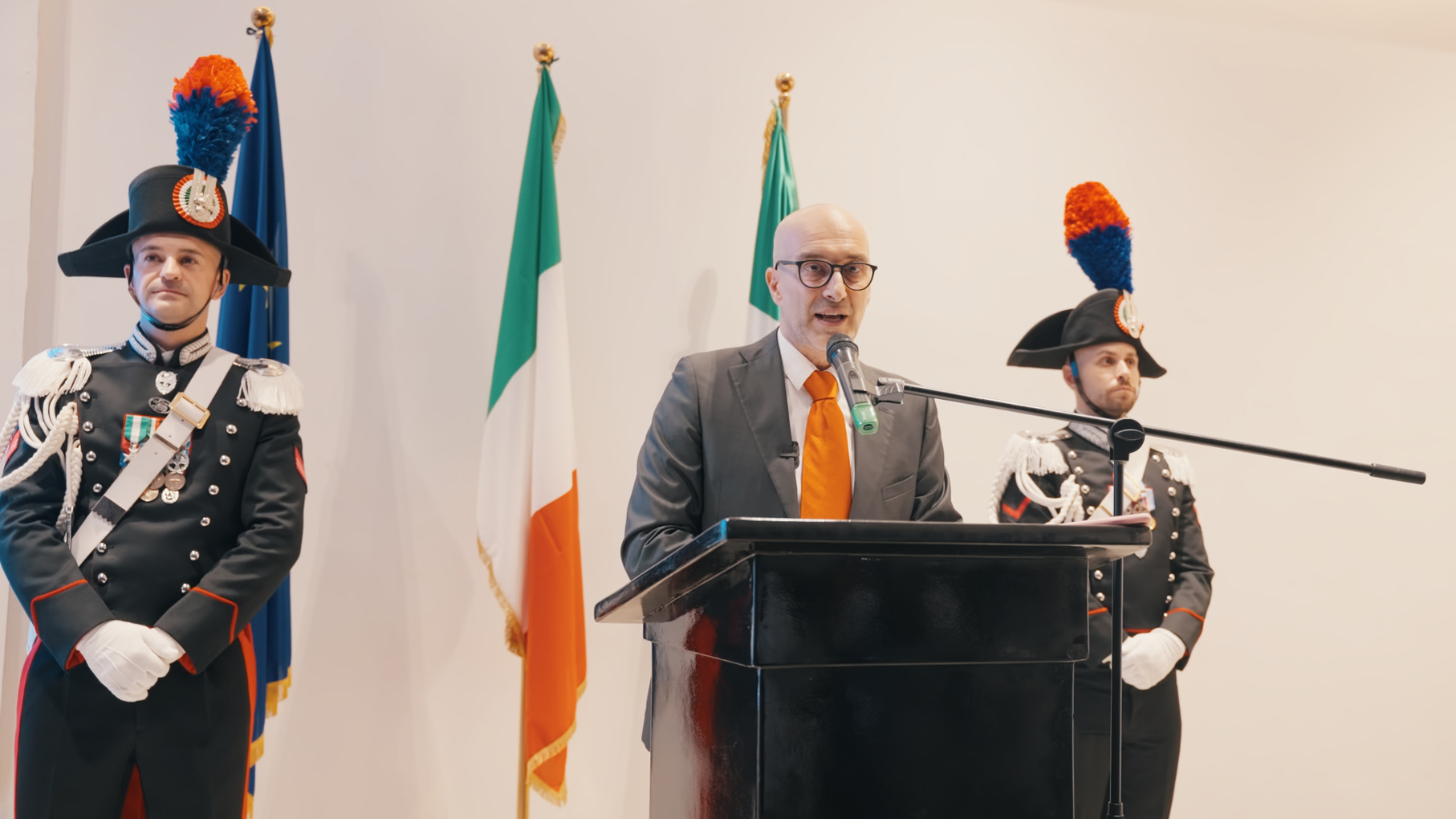
It is always with a deep emotion to host the reception for our National Day, especially in our 80th birthday.
I have three reflections to share with you.
The first is about the birthday of the Italian Republic. Our imperfect, troubled and beloved Republic. It was a long journey, that is still to be completed. Maybe it will not never be completed.
In 1946 the destructions of war were everywhere. Italy was in ruin. The shame of fascism hung inside the flesh of our country; the shame of aggression against sovereign nations such as Ethiopia; the shame of racial laws and persecution against Jews.
On that day Italians chose the Republic. They rejected the past and set up the foundations for a new society, free from blind nationalism, fascism, colonialism and oppression. We wanted to create an open and inclusive community of free, active and responsible citizens.
I briefly recall article 3 of the Constitution. It is so clear and profound that is almost poetry.
“All citizens shall have equal social dignity and shall be equal before the law, without distinction of gender, race, language, religion, political opinion, personal and social conditions. It shall be the duty of the Republic to remove those obstacles of an economic or social nature which constrain the freedom and equality of citizens (…)”
We can now look at our collective effort in these 80 years with pride. Italy has become a truly democratic and free country where every citizen has the opportunity to express himself or herself; it is richer, more united and inclusive; it is part of the European Union and of an international community built on cooperation; it is built upon solidarity, a word that resonates well with the catholic roots of Italy but has a meaning for all, regardless of their religion; solidarity for the elders, for children, for the sick, for the refugees and immigrants who come from afar.
On 2nd June 1946, for the first time, women were allowed to vote. This was the first step for women to become full citizens of our country. 21 women took place in the new Parliament: they were former resistance leaders, lawyers, workers, teachers. When they sat in the Parliament, they did not simply witness the drafting of the post-war Constitution: they wrote it.
It took decades for new Republic to correct all the distortions of law that discriminated against women. Women had to fight against stigma and prejudices. They reclaimed their dignity and their position in the society. They took control of their lives, of their bodies, of their future. They can choose any role they want, what to study, where to work, whom to love, if and when to marry, how many children to have.
Until 1981 a man who raped a woman could get away with it if he married the victim. That absurdity changed when a 17-year-old girl in Sicily refused to marry the man who raped her for 8 days.
All these changes were brought by the determination of Italian women. They shall not scare anyone. As Tina Anselmi, the first female Minister said:
“When women commit to change, their victories are victories for the whole society“
The path to real equality is far from complete. We had our first female prime minister only in 2022. Women are misrepresented in the Parliament and In the boards of main companies. salaries between men and women are often not equal. Unemployment rates are higher for women. Many women have to choose between raising a family or working. An unacceptable number of women killed every year by their husbands or partners.
Yet again, the path was clear from 1946. Women have built modern Italy, with their work and dedication.
I invite you all to see the exhibition on Italian women in the garden.
The third reflection is about article 11 of the Constitution.
Italy shall reject war as an instrument of aggression against the freedom of other peoples and as a means for the settlement of international disputes; Italy shall agree, on conditions of equality with other States, to such limitations of sovereignty as may be necessary to ensure peace and justice among Nations (…).
Peace and justice. These have been our guiding lights for 80 years. They are deeply ingrained in our collective conscience. Peace is not only the absence of war: it is the construction of a fairer, more just and democratic international system, where each nation is respected. That’s why we support the efforts of Kyiv against the aggression by Russia. As President Mattarella said yesterday in the reception for the diplomatic corps:
“We feel that the cause for Ukrainian liberty and independence is ours.”
Peace is about creating a family of democratic nations.
We are one of the six founding members of the European Economic Community in March 1957. We are part of the Atlantic Alliance and committed members of the International Courts.
Italy is an active supporter and one of the main contributors to the UN system. Our soldiers have participated in countless international peace operations. One thousand Italian soldiers are still in Lebanon under the UN flag.
We believe that United Nations is and must remain the only forum for maintaining international peace and security.
The choice is clear, said president Mattarella,
“we can decide whether to keep upholding the primacy of international law and the search for shared solutions, which stands against the logic of confrontation and discord. Fuelling the fire of resentment and hatred will only put us on the path to war and perpetual conflicts.”
Nigeria and Italy
We can say that Italy helped the development of Nigeria. Thousands of Italians came to Nigeria in search of economic opportunities. Many stayed. Companies like AGIP, which we call it now ENI, Salini. B-Stabilini. Cappa D’Alberto. Orobica, just to name a few. We hope that more companies and people will come to Nigeria to foster economic, commercial and social relations. The Embassy is ready to assist them all.
We are sure that the resolution of the long pending controversy with ENI, thanks to the efforts of the Nigerian government, will bring more investments and interest from Italy.
Italy will support as much as possible Nigeria, her democracy and her progress, and the efforts of the Nigerian government to protect all her people, regardless of their religion and ethnicity.
Last year President Bola Ahmed Tinubu was in Rome for an important international conference on the fight against terrorism; there he met with our Prime Minister Giorgia Meloni.
Later this year Nigeria and Italy will jointly chair the international conference for the replenishment of the Global Partnership for Education, the major initiative to support education in the world, particularly in Africa.
I also want to acknowledge the contribution of Nigerian migrants to the Italian economy and society. As of 2025, there are 132,000 Nigerians legally resident in Italy. They work in transportation, industry, agriculture, hospitality, commerce. They set up business. They are young and they have the highest natality rate. Not surprise, I would say.
At the end of the video, you saw a photograph of a young lady. She is Paola Egonu, the leader of the Italian women volleyball team, gold medal in Paris. Paola is Italian, born and raised in Italy. Their parents are Nigerians.
I come to the conclusion.
We Italians look at Africa as our neighbour and our partner. No country can be an island in a world interconnected facing global challenges: terrorism, international crime, poverty and the greatest threat for the whole humanity, climate change.
We do believe in a joint effort to promote peace, democracy and social justice in Africa and in the world. Each African country has its own path for development and change, according to its traditions, history and culture. And this is all the truer for Nigeria.
Italy does not teach lessons. We can only offer to Nigeria our imperfect example of a country that through decades of hard work has changed for the better.
That started 80 years ago. And it will continue.