


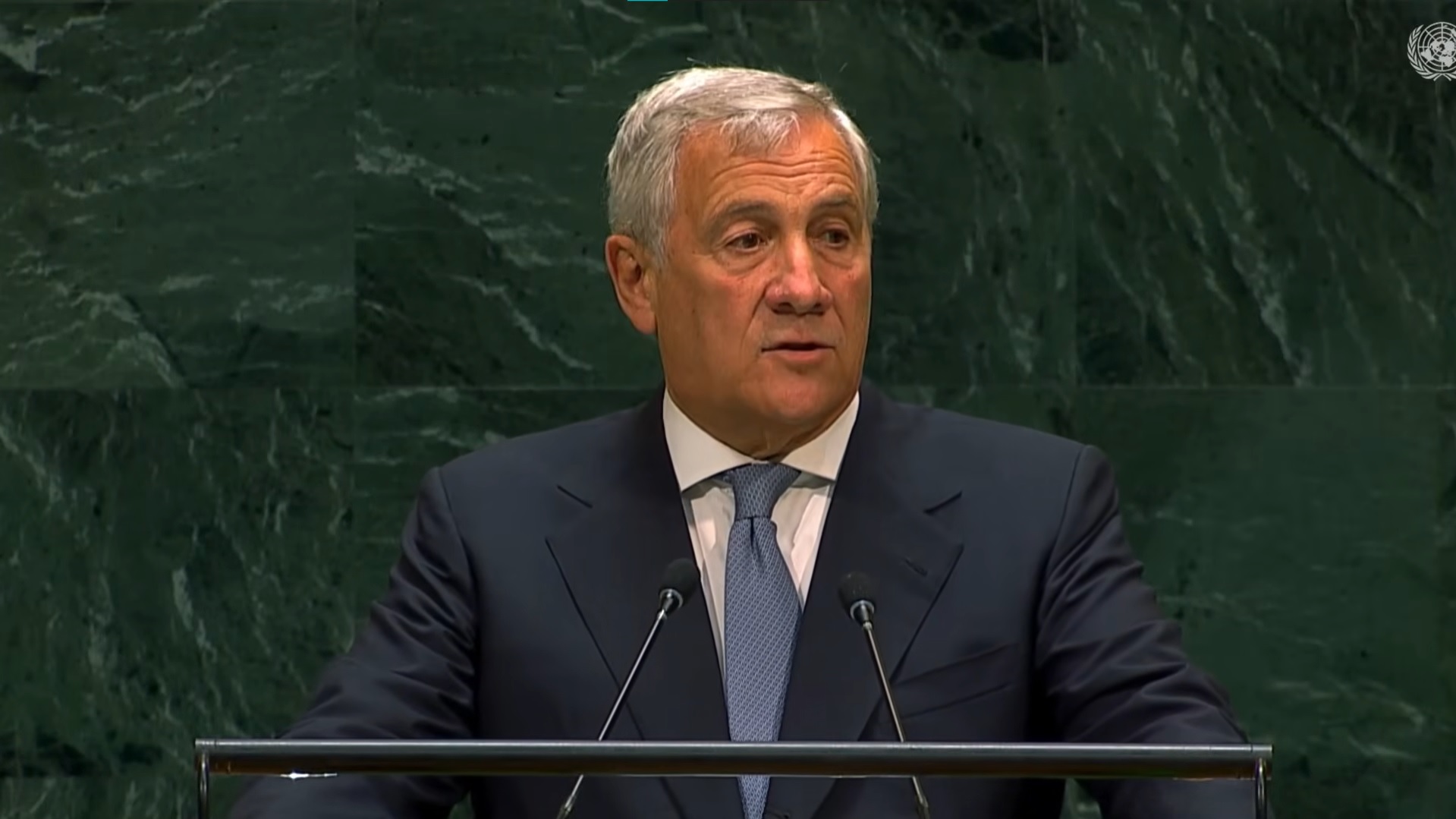
At a time marked by international tensions and increasingly widespread conflicts, Italy’s Deputy Prime Minister and Minister of Foreign Affairs, Antonio Tajani, made a strong appeal to the international community during his speech at the United Nations General Assembly.
The head of Italian diplomacy emphasized the importance of dialogue and respect for international law, warning against the risk of viewing war as an inevitable condition:
“We must not become accustomed to war. Against the law of the strongest, we choose the strength of the law. This is the mission of Italian diplomacy: to build bridges and keep dialogue open even when it seems impossible.”
During his speech, Tajani addressed some of the main geopolitical issues currently at the center of international attention: Ukraine, the Middle East, and the security of maritime routes.
Africa continues to represent a strategic priority for Italian foreign policy. In this context, Tajani outlined the objectives of the Mattei Plan, a project through which Italy aims to strengthen cooperation with numerous African countries. According to the Minister, the continent’s economic and social growth is closely linked to the management of migration flows. He therefore stressed the need to combat human traffickers and protect the so-called “right not to emigrate,” meaning the possibility for every person to build their future in their country of origin without being forced to leave.
Looking ahead to future challenges, Tajani devoted a significant part of his speech to Artificial Intelligence, describing it as one of the most profound transformations of our time.
While acknowledging its potential in fields such as medicine, scientific research, and environmental protection, the Minister urged the international community to reflect on the risks associated with growing inequalities, information manipulation, and the misuse of new technologies.
In the conclusion of his speech, Tajani renewed the call for reform of the United Nations Security Council, which he considers necessary to make the organization more effective and representative of contemporary international balances.
“We want a Council that is more legitimate, representative, and accountable to all member states. We do not need an even more exclusive club, but an institution capable of making decisions and taking action.”
According to the Minister, only more inclusive and effective multilateral institutions will be able to address the global challenges that characterize the new international context.